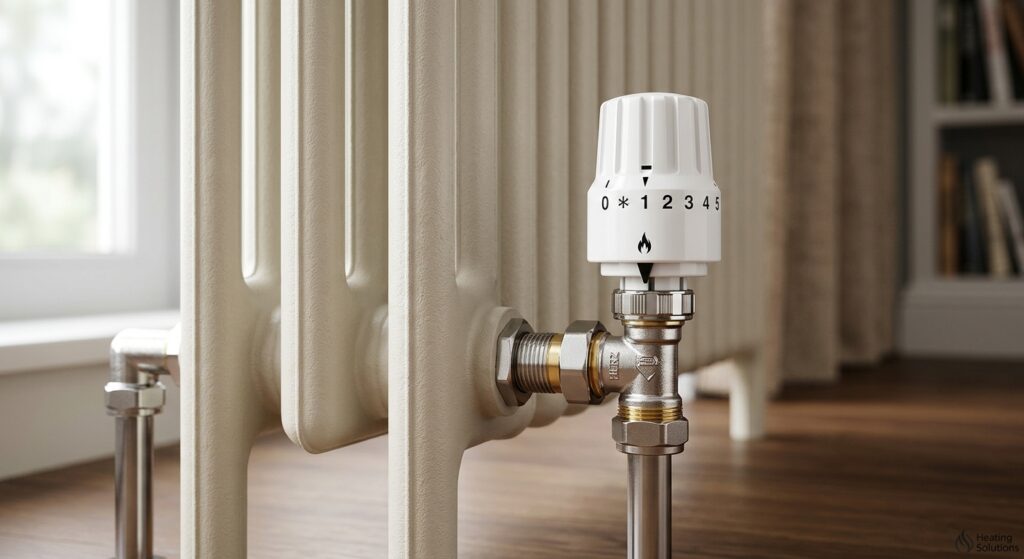
Thermostatic radiator valves, or TRVs, are fitted to radiators in millions of homes. They are designed to give you greater control over the temperature of individual rooms, helping to keep your home comfortable while avoiding unnecessary heating.
However, one of the most common mistakes people make is treating a thermostatic radiator valve like a simple on/off switch.
Turning the TRV fully up, waiting for the room to become too hot, and then turning it off completely might seem like a sensible way to control your heating. But this can actually defeat much of the purpose of having a thermostatic radiator valve in the first place.
A TRV is designed to regulate the temperature automatically, not simply provide maximum heat until somebody remembers to turn it off.
So, how should you use a thermostatic radiator valve correctly?
What is a thermostatic radiator valve?
A thermostatic radiator valve controls the flow of hot water into a radiator according to the temperature around the valve.
Unlike a traditional manual radiator valve, a TRV is designed to respond automatically as the room temperature changes.
Most TRVs have numbered settings, usually from 0 or a frost-protection setting through to 5. Although the exact temperatures vary between manufacturers and models, the numbers generally represent the approximate temperature you want the room to reach, rather than how much power you want the radiator to produce.
This is one of the most important things to understand about using a TRV.
A TRV is not a radiator power control
Setting a TRV to 5 does not normally mean that the radiator heats the room five times faster than when it is set to 1.
Instead, a higher setting tells the valve that you want the room to reach a higher temperature before it reduces the flow of hot water through the radiator.
Once the room reaches the temperature associated with that setting, the TRV should begin restricting the flow.
If the room subsequently cools, the valve can open again to allow more hot water through the radiator.
This automatic adjustment is the whole point of having a thermostatic radiator valve.
Don’t just turn your TRV fully on and then switch it off
A common habit is to turn a radiator valve all the way up when you feel cold.
The radiator gets hot, the room eventually becomes too warm, and the valve is then turned down or switched off completely.
Later, when the room becomes cold again, the process is repeated.
Although manually adjusting a TRV isn’t necessarily harmful, constantly using it in this way misses one of its main benefits.
A better approach is to choose a comfortable setting and allow the TRV to regulate the radiator automatically.
For example, if you want your living room to remain at a comfortable temperature, select an appropriate TRV setting and leave it there.
As the room warms up, the TRV should gradually restrict the flow of hot water when the desired temperature is reached. If the temperature falls again, the valve can allow more heat into the radiator.
You don’t need to continually stand next to the radiator and turn the valve on and off.
Think of a TRV as a temperature limiter
One of the simplest ways to understand a thermostatic radiator valve is to think of it as a temperature limiter.
You are effectively telling the valve:
“Keep this room around this temperature.”
You are not simply telling it:
“Make this radiator as hot as possible.”
That distinction is important.
If a room is already warm enough, there is little point in continuing to supply maximum heat simply because the TRV is set to its highest position.
The valve is there to reduce the flow when the room reaches the temperature you’ve selected.
What do the numbers on a TRV mean?
The numbers on thermostatic radiator valves generally correspond to approximate room temperatures.
A typical TRV may have settings similar to these:
| TRV setting | Approximate room temperature |
|---|---|
| ❄ / * | Frost protection |
| 1 | Around 10–12°C |
| 2 | Around 15–16°C |
| 3 | Around 18–20°C |
| 4 | Around 22–24°C |
| 5 | Around 25°C+ |
These figures are only a guide. The actual temperature represented by each number can vary depending on the manufacturer, valve design and location of the TRV.
For many homes, a setting around 3 may provide a comfortable living-room temperature.
However, there is no universal “correct” TRV setting. Different rooms and different people have different requirements.
The general principle is to use the lowest comfortable setting that provides the temperature you want.
Use different TRV settings in different rooms
One of the major advantages of thermostatic radiator valves is that they allow you to control individual rooms.
You don’t necessarily need every room in your home to be heated to exactly the same temperature.
For example, you might choose:
- A comfortable setting in the living room.
- A slightly lower setting in bedrooms.
- A lower setting in a spare bedroom that is rarely used.
- A suitable setting in the bathroom based on your preferences.
- A frost-protection setting where appropriate for a room that isn’t normally occupied.
This room-by-room control is one of the reasons TRVs can be useful for managing heating.
There is little benefit in heating an unused room to exactly the same temperature as a room your family spends most of the day using.
Can thermostatic radiator valves stick?
Like any mechanical component, thermostatic radiator valves can eventually develop faults.
One common problem is a TRV that becomes stuck.
TRVs contain a mechanism that moves to regulate the flow of water through the radiator. If the valve is left in the same position for a very long period, particularly fully closed or fully open, the mechanism can sometimes become stiff or stick.
This can be more noticeable after a period when the heating has not been used regularly.
For example, a radiator that has been left permanently switched off throughout warmer months may have a TRV that becomes difficult to move or fails to regulate the radiator properly when heating is required again.
Likewise, a valve that remains permanently fully open can potentially suffer from a mechanism that becomes stiff through lack of movement.
This is another reason why it is useful to use the TRV as intended and adjust it when appropriate, rather than treating it as a valve that should always remain at one extreme.
If a TRV appears to be stuck, don’t force the control aggressively. The valve may require inspection or servicing, particularly if it is old or isn’t responding to temperature changes.
TRVs can also fail because of age
Thermostatic radiator valves don’t last forever.
Over time, the seals, internal components and other parts of the valve can deteriorate. One of the most obvious signs of an ageing TRV is water leaking from the valve.
A small leak can sometimes appear around the valve body, connection or spindle. Even a relatively minor leak should not simply be ignored.
Radiator systems contain pressurised or circulating water, and a leak can potentially cause damage to flooring, walls or other parts of the property if it becomes worse.
If you notice water around a radiator valve, place appropriate protection underneath it where possible and arrange for the valve to be inspected by a suitably qualified heating professional.
In some cases, the most sensible solution is simply to replace the old TRV.
Modern thermostatic radiator valves are available in a wide range of styles and can provide more precise temperature control than older models.
Don’t cover your thermostatic radiator valve
For a TRV to work properly, it needs to sense the temperature of the surrounding air.
If the valve is covered by curtains, furniture or other objects, the temperature immediately around the valve may not accurately represent the temperature of the room.
For example, if a TRV is hidden behind heavy curtains, warm air from the radiator can become trapped around the valve.
The TRV may then sense a higher temperature than the rest of the room and reduce the radiator’s output before the room as a whole has become comfortable.
Keeping the area around the thermostatic radiator valve reasonably clear allows it to sense the room temperature more effectively.
What should you do if a room is too hot?
If a room consistently becomes too warm, don’t automatically turn the TRV completely off every time.
Instead, try reducing the setting slightly.
If you normally have the valve set to 4, for example, try setting it to 3 and allow some time for the room temperature to stabilise.
Small adjustments are often more useful than continually making large changes.
Remember that a room takes time to warm up and cool down. Avoid adjusting the TRV every few minutes simply because you haven’t immediately noticed a difference.
What should you do if a room is too cold?
If a room remains too cold, first check the TRV setting and make sure the radiator is operating correctly.
If increasing the TRV setting doesn’t resolve the problem, there may be another reason for the room remaining cold.
Possible factors include:
- Poor insulation.
- Draughts or air leakage.
- Cold external walls.
- Windows with poor thermal performance.
- A radiator that is too small for the room.
- Problems with the heating system or radiator.
- A faulty or stuck TRV.
Simply turning the TRV from 3 to 5 won’t necessarily solve an underlying heating problem.
A TRV controls the temperature at which it reduces the radiator’s heat output. It doesn’t increase the boiler’s heating capacity or make an undersized radiator capable of heating a room beyond its limitations.
Don’t confuse a TRV with your central heating thermostat
It’s also important to understand the difference between a thermostatic radiator valve and your main room thermostat.
A central heating thermostat generally controls when the heating system needs to provide heat based on the temperature in the area where the thermostat is located.
TRVs provide more localised temperature control at individual radiators.
For example, the main thermostat may determine whether the heating system is running, while the TRVs help determine how much heat individual rooms require.
This is why the positioning and settings of both controls matter.
A TRV cannot create heat by itself. It regulates the heat supplied to the radiator.
Do TRVs save energy?
Used correctly, TRVs can help prevent rooms from being heated unnecessarily.
For example, there may be little reason to maintain an unused bedroom at exactly the same temperature as a busy living room.
However, simply installing TRVs doesn’t automatically guarantee lower energy bills.
Their effectiveness depends on a number of factors, including your heating system, insulation, room temperatures, controls and how you operate the system.
The benefit comes from using the controls intelligently and avoiding unnecessary heating, rather than simply turning every radiator valve down as far as possible.
A simple rule for using thermostatic radiator valves
If you’re unsure how to use your TRVs, remember this simple rule:
Set the TRV to the temperature you want, rather than turning it fully up whenever you’re cold.
Then give the valve and room time to respond.
If the room is too cold, increase the setting slightly.
If it’s too warm, reduce the setting slightly.
Once you’ve found a comfortable setting, you generally shouldn’t need to keep adjusting it.
And don’t forget that TRVs are mechanical devices. If a valve has been left fully open or fully closed for a long time, it can become stiff or stuck, while older valves can eventually develop leaks or other faults.
The bottom line
Thermostatic radiator valves are designed to make heating your home easier and more controllable.
Their purpose isn’t simply to provide another switch that you turn fully on and fully off. They are designed to automatically regulate the heat from a radiator according to the temperature of the room.
So, rather than turning your TRV up to maximum, waiting until you’re too hot and then switching it off, select a comfortable setting and allow the valve to regulate itself.
Use different settings in different rooms, make small adjustments when necessary and keep the area around the valve clear.
It’s also worth remembering that TRVs can wear out. Valves that are left permanently open or closed for extended periods can become stiff or stick, while older valves may eventually develop leaks. If a valve isn’t operating correctly or is showing signs of leakage, it should be checked rather than simply ignored.
Once you understand what the numbers mean and how the valve is designed to work, a TRV becomes much more than a simple radiator control.
Set it, let it regulate, and avoid treating your thermostatic radiator valve like an ordinary on/off switch.
Leave a Reply